


Many people believe starting a new business is a hard thing to do. The way the business world is currently talking about the mortality rate of startups is wrong.
Most of the industry publications have very similar lists of what causes startup failures. They usually cite generic words such as "poor planning", "no market research", and "bad location".
These types of comments only scratch the surface of how a company dies. Rarely does a startup experience failure in one dramatic moment or through one single incident.
Instead, most times failure occurs during a slow and constant decline over time.
A business may fail due to something as simple as the owner forgetting to create a business plan, or the business may fail because of a negative cash conversion cycle where the owners cannot afford to pay for their businesses until they receive money from their clients (e.g., net-60 receivables).
Additionally, the business may have experienced initial traction but at a tremendous cost for acquiring customers, which continues to reduce profit margins as the business attempts to grow.
Operators of a business must understand the specific mechanics of how a business fails and they must be able to identify the signs of a potential failure.
An operator should be familiar with the actual differences between a company that appears to be successful on paper versus a company that is economically healthy.
Summary/key ideas of mechanics of business failure
Understanding the mechanics of failure is critical to the operator of a new company.
In advance of an explanation of the mechanics of failure, it is useful to visualize the types of failure that typically occur with a new business.
Pre-launch
Building on polite interest rather than supported or proven demand (i.e., verified, paid demand).
Launch
Achieving early success with early adopters and dependence on unsustainable or not-enough-sustainable channels.
Preliminary traction
Revenue is increasing but unit economics have been turned upside down. As a result of rapid revenue growth, a business is losing cash at an increasingly fast pace.
Future stages
As operational bottlenecks are overcome, employers will make significant mistakes in recruiting and hiring which lead to problems including bloated fixed costs, poor execution, and difficulty raising capital.
After going through this early phase of growth, an organization must assess how far along they are in the timeline of growth to determine the length of time it takes to make a positive cash flow before making any future business decisions.
Why new business fail
One of the biggest mistakes of the new business founder is the idea that if they have revenue, they will survive.

Revenue does not equate to survival.
Our analysis of business failure shows a huge gap between an entity appearing to be successful, but actually viable.
A startup may have hundreds of satisfied users or have a large number of clients, but in reality, it may only be weeks away from going bankrupt.
In many cases, this gap occurs because of a lack of understanding of the difference between cash flow and profit.
Profit is an accounting definition; cash flow is oxygen for a business.
A business may sell $100,000 worth of inventory in a month, but if their clients have a 90-day period in which to pay them, they will be profitable.
If the business's suppliers have due dates to be paid within 15 days, the business is bankrupted.
The main issue here is that while we all want to avoid making mistakes, we must build companies that are stable enough to survive through the inevitable volatility of the market; delayed payments; and the operational friction that all businesses encounter.
Business failures during each stage: The way businesses fail
A business's first day of operation does not come with the same level of risk and exposure as the business's one thousandth day.

As organisations grow and evolve, so do the vulnerabilities that they face during that growth period.
To better enable the founders to anticipate structural breaks, it is essential for them to identify the evolution of vulnerabilities.
Pre-launch: The "friendly interest" trap
The most common failure mode occurs before a business starts operating and is a trap that many potential entrepreneurs face, unvalidated demand.
Unvalidated demand may also be referred to as "friendly interest."
Entrepreneurs tend to look for validation from others to support their idea. Entrepreneurs often ask family, friends, and social media followers if their idea has merit.
As a consequence of this search for validation, many people—due to the social pressure created by giving a negative response—agree with the entrepreneur's assessment of the concept and say, "Yes, I would buy that."
It is important to bear in mind that this type of response is not an example of market validation, but rather, it is avoidance of friction in social situations.
Example
A first-time founder spends six months and their entire savings in developing a specialised software application or securing a commercial lease for a niche retail store.
The founder uses a survey to forecast the number of customers they will have at launch based on 80% of survey respondents indicating that they "love the concept" and expects based on this data that the launch day will yield high conversions.
However, their conversion rates are virtually zero.
Diagnosing the problem
Until money has changed hands or a considerable amount of friction is removed from the purchase decision, demand is not valid.
Are people pre-purchasing? Are binding letters of intent signed? Are they giving you their email address and actively opting in to receive updates?
If the only validation provided is verbal support with no money changing hands or pre-purchasing, then there is a substantial risk that the founder will face a failure to generate demand.
Solution
Administrate the transaction early. Create a landing page with a small ad budget and solicit conversions prior to creating the product.
Pre-sell the service.
If prospective customers are not willing to purchase through pre-sale transactions or allocate time and effort toward an inferior early version of the product, they certainly will not purchase the final perfected version of the product.
Launch: When the initial sales are a false positive
One of the most common issues associated with launching a new product is the spike in initial sales resulting from affiliation with friends, family and early adopters who like trying new things.
While this spike creates a false sense of product-market fit, it can put companies at risk of overextending themselves.
The situation
A consumer packaged goods company launches a product and, as a result of marketing through their own personal network and a viral social media post, sees an immediate influx of purchases.
The company thinks it has hit the jackpot, so the owner places an order for a large volume of inventory.
Three months later, the owner has exhausted their personal network and the viral post has lost its virality.
The company is left with lots of depreciating inventory and no clear path to acquire additional customers.
The analysis
You have a channel dependence issue. Review your sales data.
Is all your revenue coming from one source? Are those customers highly unique and not representative of potential customers in the larger market?
If you shut off that one channel that was working for you, would your revenue drop to zero?
The solution
Look at early sales as a testing ground, not as a permanent baseline.
Immediately start experimenting with secondary and tertiary customer acquisition channels. Do not base your inventory or fixed costs on a testing channel that is not repeatable or proven.
Initial success: The big deal vs. the reality of scale and economics
The early traction success stories are the ones where most of the hauntingly painful failure stories occur.
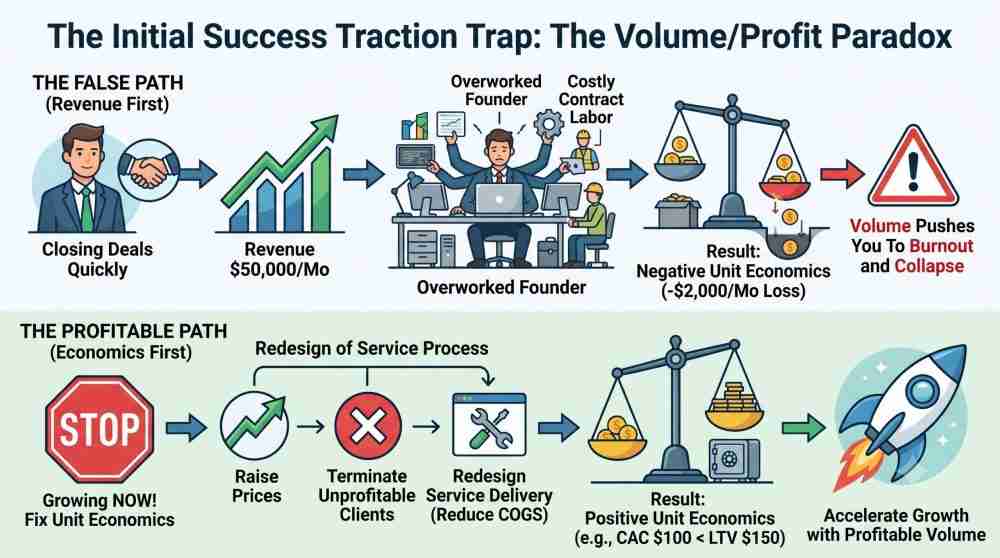
In these instances, while the company is generating meaningful revenue, the team is feeling successful, but the underlying mathematics are flawed.
The scenario
A business-to-business service provider has early traction levels that are through the roof. The company is closing deals quickly.
In order to perform against these deals, the business owner is working 80 hours a week and utilizing costly contract labor at a rate of pay that crushes the unit economics of each deal.
The business is losing money.
It makes $50,000 per month but loses $52,000 per month delivering its services and covering fixed overhead.
The founder’s solution is to push for more growth and volume. The result of that decision is to drive themselves and their employees to burn-out and ultimately collapse.
Diagnostic
The unit economics do not match.
You must know your Customer Acquisition Cost (CAC) and your gross margin per unit/project, i.e. how much it costs to acquire a customer and what their lifetime gross profit is for you.
If you spend $100 on marketing and sales to acquire a customer and they only generate $80 in total gross margin for you during their lifetime, any volume you achieve in sales will only increase your rate of failure.
Corrective action
Stop growing NOW!!!! Growth hides poor operational practices. Fix your unit economics before you continue to grow.
To do this you need to either raise your prices, terminate clients who are not profitable or redesign the way you deliver services to reduce your Cost of Goods Sold (COGS).
You should only accelerate your growth once you can reasonably prove that each unit of sale is worth making a profit on.
Scaling: Operational bottlenecks & over-hiring
Once your company has reached genuine & profitable Product-Market Fit a new set of potential failures develops.
Your organization has now outgrown its initial business model and infrastructure.
Scenario
A solo founder has an overwhelming amount of requests for their product and as a result, they quickly hire three employees; a marketer, an administrative assistant and an operations manager.
Because the urgency to hire is greater than the need to hire based on defined job descriptions, the founder becomes a manager of untrained and/or poorly trained staff vs. doing the actual tasks of running the business.
This results in lower quality of products/services, increased customer attrition and a higher fixed cost of operation caused by the addition of new payroll.
The company is losing money while the founder continues to work hard.
Diagnosis
Look out for organizational drag.
Are your customers making more complaints? Is your time-to-delivery getting longer?
Is the founder spending most of his time chasing fires within the company versus selling?
Corrective action
Take your time to hire new employees and ensure they fit into your culture and understand the business's needs.
Before hiring a new employee, ensure you have defined what it means to be successful and what each employee's core responsibility will be.
Do not create a permanent hire to accommodate a temporary surge in demand; instead, look to contractors or employment agencies as needed for flexibility.
Only add permanent staff when your recurring revenue can easily cover their full burden, AND their presence has removed an obstructive issue or process that inhibits revenue generation.
Cash flow disconnect: Surviving the valley of death
The most important concept that a business operator can understand is cash flow management. Most money-making businesses go out of business due to poor timing of cash.

Cash flow refers to the timing of when money comes into and goes out of your company's bank account.
A perfect situation would be if your customers paid you immediately, and you paid your suppliers later. But reality often turns out to be quite the opposite.
Warning signs of cash flow problems
A shift from a healthy situation to a critical situation can occur in a matter of weeks. Therefore, founders must monitor their cash rather than wait to see the bank balance drop to $0.
A significant red flag for cash flow problems is a high concentration of customers.
If the founder relies on one or two customers for over 30% of the business’s total revenue, those customers do not just create income for the business, but rather create the risk of the business’ existence.
If clients delay payments for 45 days, will you make payroll?
Another indicator of cash flow issues is the increase in AR (Accounts Receivables) aging.
If customers were paying their invoices in 15 days before and are now taking 45 days to pay them, this is usually a sign of a broader macroeconomic recession or tightening and you are now providing unsecured loans to your customers.
Additionally, take note of hidden fixed expenses.
Subscriptions to software services, vacant office space, and retainers for services not being used consume cash, and at the end of the day, when revenue dips, these hidden costs become heavy anchors.
Stemming the cash flow bleed
When the cash runs out, many founders go into survival mode. You must take immediate and aggressive action.
1. Accelerate receivables
If customers are paying off their invoices faster than usual or not paying on time, then offer discounts (2%) for payment within 10 days. Get on the phone with your customers.
Avoid sending passive email reminders for invoice payments to the accounts payable department. Call the decision-makers directly.
2. Stretch payables
If you can, request net-60 payment terms from vendors you work with.
Most suppliers would rather tolerate delayed payment than lose their customer or force them to default.
3. Cut all fixed costs immediately
Don't wait to see if next month is going to be better.
Postpone planned hires, cancel any unused software subscriptions, and eliminate anything that does not directly contribute to customer retention or generating new revenue.
Founder psychology and delays in decision making
While mechanics and metrics are crucial indicators of business health, human behavior plays a major role as well.
As a business owner you are naturally optimistic and have a bias towards optimism.
However, when the situation turns hostile, your optimism may become a liability.
This creates a delay in decision making and creates an interval between when a decision should be made and when that decision is actually executed.
When a founder has established a new product line that isn’t doing well, founders will wait six months to make the decision to terminate that product line in hope the product will turn around.
When founders determine that one of the new key hires is either a bad employee or not competent enough to be hired, the founder waits to make the decision to terminate the bad hire because they want to avoid having to have an uncomfortable conversation.
Additionally, when a founder knows they should raise prices, they will wait a year to raise prices, fearing that they will lose customers if they raise prices.
As a result of decision latency, founders destroy their company’s cash runway, adding to the overall loss of money.
Each month that a founder delays making a hard decision will deplete the company’s cash reserves, depleting their cash reserves even more when the company will need those cash reserves to survive in the future.
In addition, the best operators of a company do not make fewer mistakes than other operators; they simply recognize their mistakes sooner, and take action to fix those mistakes.
They do not take their mistakes personally, or as an indication of how good or bad they are.
If they find that their data indicates that the market does not accept their current pricing model, they will adjust and pivot. They won’t argue with the market.
Final verdict: Survival is essential to building a company
In the early years of a company, the number one priority for a new startup is to simply survive.
Surviving allows for iterating, ultimately leading to success.
To avoid failure as an entrepreneur, throw out the actual generic clichés.
Instead, build a solid financial dashboard for your business to monitor your company’s cash runway, your product’s unit margins, and your customer acquisition cost.
Additionally, do not develop your product based solely on what polite and pleasant feedback you receive from others; instead, demand a firm commitment to buy the product.
Recognize that early traction can be deceiving if the foundational economic model is flawed.
Founders should build a business around the belief that everything that could go wrong, will go wrong.
Founders should build a business around the notion that clients will pay late, advertising costs will increase, and that the first major employee will not work out.
By developing a business with a margin of safety and a full understanding of the point of failure, founders will be able to overcome the tumultuous nature of starting a business, which is the reason most start-ups fail.
Frequently Asked Questions (FAQs)
How much cash runway is it advisable for new businesses to hold?
It varies by industry but the general recommendation is that new businesses should hold at least six months of operating expenses.
Holding six months of cash will allow a business to remain operational for six months if revenue were to stop.
For businesses in capital-intensive or volatile industries, it's normal to hold a runway of at least nine to twelve months' worth of operating expenses in order to survive prolonged downturns and/or product delays.
What is the difference between cash flow and profit?
While profit is a measurement of revenue minus expenses on an accounting basis, cash flow represents the physical movement of cash into and out of your bank account.
Even though a business may show a profit on its financial statement as a result of a large invoice to a client, until that client pays the invoice the business has a negative cash flow and cannot use the profit to pay current bills.
What is the best time to hire an employee?
You should hire when there is an operational bottleneck that is preventing the business from generating more revenue than what the employee would cost.
Do not hire for convenience or for prestige.
The employee should be hired when the consequences of not hiring them are preventing the business from reaching its optimal unit economics.
How do I validate my research market?
Research is only valid if it is measuring actions as opposed to intentions.
Historically, market research in which survey participants say they "would" be interested in a product are notoriously inaccurate.
Valid research involves some degree of friction, such as requiring potential customers to place a deposit, sign a binding agreement, or exchange valuable contact information for early access.
If people are unwilling to have friction, then the demand is not legitimate.
