


Forecasted to reach $11.06 billion by 2030, the software automation sector is suffering a devastating failure rate with only 8 percent of companies using their automation systems effectively according to Forrester's research.
Many organizations are trapped in their decisions regarding which types of saas marketing automation tools to purchase by entry-tier pricing alone, rather than by evaluating the speed of sub-60 second triggers, potential risk during migrations, and their total cost of ownership.
The following guide provides an organized breakdown of the fifteen primary systems available in the market today, in order to align system functionality with the two principal revenue models being product-led and sales-led.
Migration Costs and Total Cost of Ownership
Hidden Fees and Pricing Traps
Most often vendor entry-level pricing for automation software proves to be misleading, providing a very appealing introductory price that upon implementation becomes much more expensive to maintain once incorporated into an organization's daily operations.
By modeling the pricing based on a normal volume of approximately 25,000 contacts, you will discover that the monthly run rate for year one of your subscription typically multiplies three to five times as compared to year one.
Additionally, you need to factor in the number of mandatory onboarding fees that will be charged to your credit card. For example, HubSpot requires its users to pay an estimated $3,000 simply to establish their Professional tier, with their Enterprise tier requiring a substantial upfront payment of $7,000 just to activate their platform. This is a fixed cost that no negotiation can eliminate.
Another often ignored area regarding the cost of ownership is the sudden increase that occurs when a user exceeds their initial contact tier limit. A user may see an increase in their monthly invoice of as much as $250 simply from surpassing the limit of 2,000 contacts in a lower tier. Furthermore, several systems count unsubscribed and archived contacts against a user's billing limit, necessitating that the user continues to pay for non-existent data.
Moving Data and Payback Periods
Finally, the migration process from a basic email marketing product to fully equipped saas marketing automation tools typically incurs a migration fee ranging from $5,000 to $15,000. This estimate accounts for the cost of direct data transfer, addressing deliverability issues, the re-warming of dedicated IP addresses, and the temporary decline in productivity due to new staff learning how to use the new interface.

On average, the payback period for acquiring a customer for software companies is about 15 months. However, you can reduce that to the optimal five- to nine-month time frame by purchasing only software solutions that match your current business requirement and data volume. Purchasing too much software for your business stage will significantly affect your ability to reach that goal.
According to Gartner's report, the use of marketing technology dropped to 49%. These platforms are also indicated to be actively utilized by fewer than 40% of users on a daily basis. Therefore, only purchase software products that will meet your current business and data volume needs.
Growth Models and Event Triggers
Product-Led Startups
The growth model and the realities of event triggers are two very different ways to acquire users, which results in differing requirements for software. For example, a product-led company at a $600,000 recurring revenue level would not be successful using email tools that only allow them to send generic messages.
Product-led companies typically reach a maximum of 3% trial-to-paid conversion rates as the tools they use prevent them from sending messages based on events that happen within their application. These companies need systems that support custom event data and allow them to trigger an immediate action within 60 seconds.
Sales-Led and Hybrid Teams
Sales-led companies typically experience different challenges. A sales-led company operating at $2 million in revenue typically reaches an impasse when it identifies significant workflows that can only be accessed at higher pricing tiers. Sales-led companies typically rely heavily on a well-integrated CRM that accurately passes lead scores back to their sales team.
When hybrid models grow to $5 million in annual revenue, they require the addition of expansion teams with workflows that will trigger once an account reaches a specific seat count or accumulates additional revenue.
Security and Legal Risks
When selecting a vendor, you must account for the risk associated with security and legal compliance, as failure to comply with these requirements could expose your company to significant financial consequences. Errors made within the visual builder of a vendor can lead to catastrophic outcomes.
In addition to the above, there are several areas where the risk of fines is considerable:
Financial Penalties: The omission of a mandatory address block from an email template may lead to violations of the CAN-SPAM Act. As such, violators may be subject to fines of up to $53,088 for each email.
Message Timing Laws: Messages sent outside of strict local-time windows may constitute a violation of federal and state laws regarding telemarketing. Penalties could be $1,500 for each violation.
Revenue Leakage: Failure to receive payment for monthly recurring revenue could cost software companies (on average) 5% to 8% of revenue each month. With a correctly optimized dunning recovery cadence, these companies could recover 30-50% of lost accounts.
Core Evaluation of 15 SaaS Marketing Automation Tools
1. HubSpot Marketing Hub
HubSpot serves as the "primary engine" for many sales-led software companies. HubSpot's marketing scoring aligns sales notification perfectly with the marketing scorecard according to industry standards, but HubSpot's pricing structure scales aggressively. On the Professional tier for 25,000 contacts, you will pay between $1,190 and $1,440 monthly. Additionally, there is a $3,000 onboarding fee.

This platform is most beneficial for managing complex deals when three or more buyers from within the same account are engaging with your content. HubSpot has introduced AI agents within the application to help you build workflows, but you need to monitor these AI agents carefully to avoid the possibility of looped errors.
2. ActiveCampaign
This platform has sophisticated visual automation capabilities at the mid-market price range that will make it highly competitive amongst other mid-market competitors. If you're looking for a database of 25,000 contacts, the Plus plan for ActiveCampaign has a monthly cost between $145 and $400, making it an affordable option for companies trying to maintain low overheads while creating advanced conditional logic.
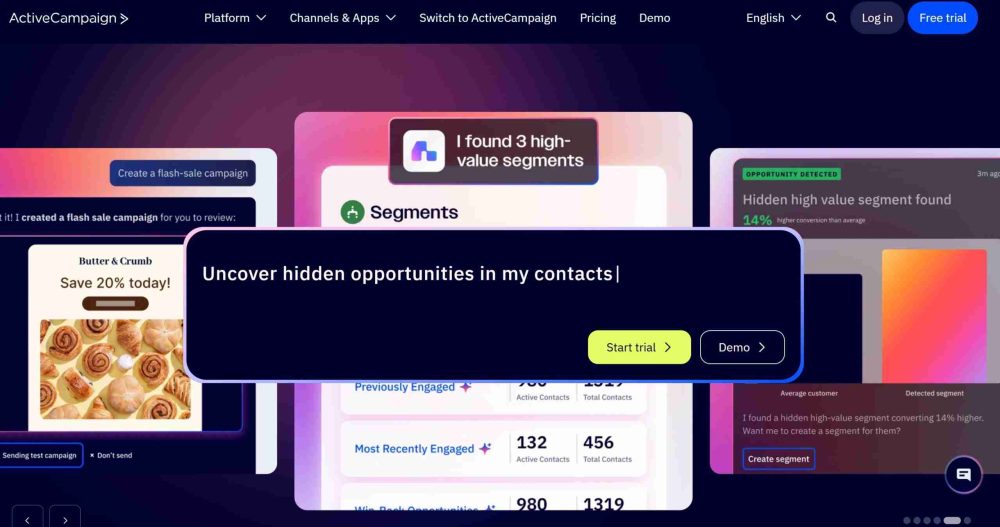
Other features of ActiveCampaign include the smooth synchronization of conflicting fields with its health-score tracking system. However, the software does not have extensive enterprise reporting capabilities like many of the larger competitors. Therefore, if you want strict cost control and maximum value, this product may be worth considering.
3. Customer.io
The Customer.io platform is geared towards companies that want to create a culture of product-led growth; it collects the raw event data generated by your pipelines (e.g., Segment) and makes that data immediately available for processing and analysis. Pricing for the platform increases as the number of profiles increases linearly, providing finance teams with a reliable forecasting model for the future.

Startups looking for sub-60-second in-app triggers will find this tool easily meets their needs. Also, because of this system's ability to collect company-level data natively, companies can use it to track their entire account rather than just individual users.
4. Adobe Marketo Engage
Marketo provides the software foundation for enterprise software companies earning $20 million or more in revenues per year. The tool can also handle the complex calculations for multi-touch attribution over the course of 12 to 18 months of business deals.

Once again, Marketo meets the highest standards of enterprise-level security—SOC 2 Type II and ISO 27001 compliance—allowing your organization to achieve compliance with many regulatory requirements. This product requires an advanced degree of technical expertise in order to be successful. Marketo is designed specifically for global enterprise lead routing, and thus it is likely to overwhelm smaller firms with so many features.
5. Salesforce Marketing Cloud Account Engagement (Pardot)
Pardot is essential if your company heavily uses Salesforce CRM. The tool allows you to track multiple business content downloads and push necessary multi-touchpoint data directly into your sales pipeline. Similar to Marketo, Pardot requires a high level of technical skill and knowledge to successfully set up and maintain.

Integration between the two systems enables teams to conduct accurate cohort analyses that will show if automation has indeed reduced customer acquisition expenditures as opposed to contributing noise to an already complicated process.
6. Iterable
The Iterable platform allows teams to send cross-channel communications to millions of unique mobile and web users, while complying with the strict local-time delivery windows dictated by the TCPA.

Iterable's integration with most major data warehouses, including BigQuery and Snowflake, adds considerable power through deep integrations with Iterable.
7. Braze
Braze is a very large enterprise engagement platform that specializes in mobile-first products, offering one of the best real-time data streaming capabilities available in the industry today. This platform can be used by teams that are actively monitoring behavioral cohorts on a daily basis in order to increase daily active usage metrics.

Although the entry price is quite high, and migrating your team's existing technical systems to Braze will be complicated, the level of detail provided through this platform can generate measurable returns for companies that operate using complex retention rules or custom health scoring models.
8. Klaviyo
Klaviyo is a leader in the online retail vertical, but it has done a great job of making the transition to a software-as-a-service (SaaS) model. It allows you to quickly track custom events as they occur and provides a lot of flexibility in how you track dynamic data.

Klaviyo does not have some of the more advanced B2B lead scoring and nurturing logic that many high-volume sales teams need, but it can effectively manage data for a product-led company that has a strong focus on fast user activation and rapid growth through self-serve billing upgrades.
9. GetResponse
GetResponse primarily serves smaller teams that want to start automating their processes easily.
The platform provides a simple way to manage their sales pipeline and has basic webinar management capabilities. Pricing for new users isn't too much money, but users should read the guidelines for contact tiers closely to ensure they don't incur unexpected costs. It has basic lead scoring capabilities but does not meet the needs of companies with complex PLG models due to extreme sub-minute latency.
10. Brevo
Brevo is the name of the newest version of Sendinblue, whose pricing model is based on the number of emails sent each month rather than the number of contacts in your database. This presents significant savings opportunities for software companies with large free-tier user bases; you can store up to 100,000 inactive users in your database without financial repercussions.

While this model handles basic onboarding and some simple dunning workflows, it does not have the advanced tracking capabilities required for comprehensive account-based marketing. However, this new pricing structure allows Brevo clients to effectively manage their operating costs.
11. Apollo
Apollo has transitioned from a pure cold outreach database to include sequential automation tools. This means Apollo is focused on providing immediate outbound sales rather than providing the infrastructure for creating deep, multi-month inbound marketing experiences.
Therefore, a content-led B2B SaaS business cannot use Apollo for managing their entire customer lifecycle. However, for a sales-led team looking to automate immediate email touches based on rapidly emerging internal leads, Apollo is an excellent choice as a highly aggressive sales engine.
12. Mailchimp
Mailchimp is typically the first place many new software projects start. It can easily handle standard newsletter campaigns and basic welcome emails.

However, for product-led growth companies that are beginning to have over 200 active customers, Mailchimp becomes an incompatible option. Unsubscribed contacts are charged by the billing tier and do not have the proper custom event triggers needed for complete product integrations. As such, this is only intended to be used until something more suitable can be found.
13. MailerLite
MailerLite has an easy-to-understand graphical interface for early-stage businesses. Compared to other established solutions, this tool allows users to set up automations more quickly. Creating a 10-step automation in less than 30 minutes is easy for a non-technical user.

Pricing for MailerLite is transparent, with no hidden tiers. While it does not have the depth of features associated with products that would be required by large sales teams, it offers superior solutions for simple software products.
14. Encharge
Built with B2B SaaS and product-led growth companies in mind, Encharge allows for automatic messaging flows based on several events including the expiration of free trials and rejected credit cards, all of which can integrate with billing platforms like Stripe and Chargebee.
You can incorporate dunning recovery directly into the visual editor. Encharge is a great solution for hybrid SaaS because it allows for advanced behavioral targeting, while still being affordable compared to enterprise solutions.
15. Userlist
Userlist is focused strictly on the messaging of customers for software. Userlist takes an account-centric organizational structure, resolving many of the issues faced by other systems by grouping customer accounts based on their parent company.
Userlist provides health scoring tools for each account, as well as a very effective product for onboarding users at a company level. Userlist's entire product is purposely narrow and as such does not have a feature-rich lead capture tool, instead focusing completely on lifecycle management after sign-up.
Choosing Systems Based on Real Costs and Event Latency
Aligning with Your Growth Strategy
When selecting the automation system for growth in SaaS, the system must directly align with your company's growth strategy. The data indicates that purchasing generic platforms leads to a 49% utilization rate because many people do not utilize them as they did not fit the vendor's growth strategy, wasting thousands of dollars in monthly fees due to lack of efficiency.
For instance, in a sales-led organization with revenues between $2 million and $5 million, the high total cost of ownership of platforms such as HubSpot or ActiveCampaign must be taken into account to guarantee that the sales floor receives the best possible lead scores. Conversely, with companies utilizing a product-led growth methodology, generic systems are to be avoided. Instead, emphasis must be placed on raw event latency and account-centric tracking through platforms such as Customer.io or Userlist.
Looking Past the Entry Price
Your assessment of any entry-level price for saas marketing automation tools needs to be conducted with a prejudiced view. You need to disregard the upfront price or entry price of any automation system entirely. You should build out your cost analyses based on the scalability aspect of 25,000 contacts, include all required onboarding costs in your financial projections, and test your team technically before making any annual commitments.
Make sure you select an automation system that adheres to stringent compliance guidelines to avoid the potential of excessive privacy fines. The key to success in this area is to audit all your feature utilization after six months, fine-tune your dunning recovery timelines, and measure the number of days the new automation has decreased the baseline customer acquisition cost payback period.
